Unit 08_ Workflow of Studying Anatomy
- seobin051013
- 5월 19일
- 2분 분량

Anatomy in Classical Greek Sculpture
The etymology of the word “anatomy” itself—where the ancient Greek “ana” means “ separate” and “tomy” means “cut”—intuitively reveals that the discipline of anatomy originated in ancient Greece.
The Greeks of that era viewed the human body as an “ideal form,” and they reflected their aesthetic exploration of the human body—such as the question, “What does the most beautiful and perfect human look like?”—in their study of muscles and proportions by observing the physiques of athletes.
Therefore, a core concept of ancient Greek sculpture is that all parts—from the fingers to the arms, from the arms to the upper arms, and from the upper arms to the torso—must be in proportion to one another. In other words, for them, a good sculpture meant that all forms were harmoniously connected.

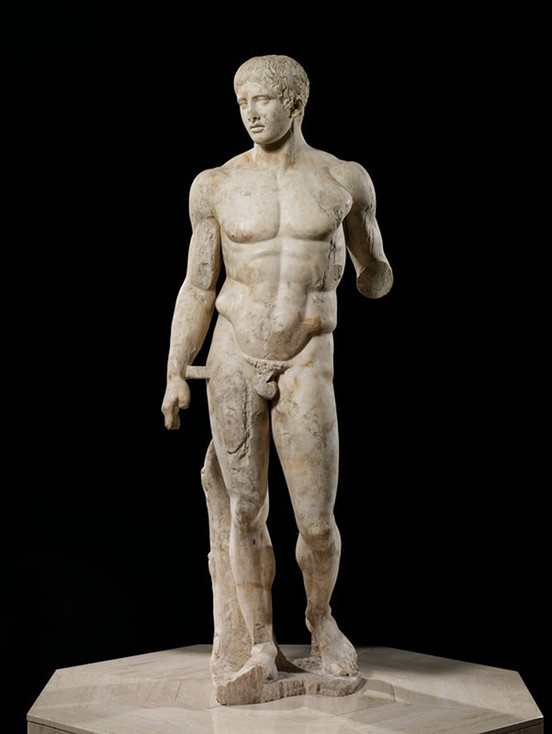


The most important figure in this field of study is Polykleitos, who is sometimes called the “scientist of aesthetics” for his attempt to mathematically explain bodily proportions, balance, and muscular harmony through his theoretical treatise Canon. His masterpiece, the Doryphoros, can be considered a practical example of the Canon; it is evident that the balance and proportions of the head, body, arms, and legs, as well as the contrast between muscle tension and relaxation, were designed and executed in a highly systematic manner.
Additionally, the Discobolus, one of the famous masterpieces of ancient Greek sculpture, was created by Myron, the “sculptor of motion.” He captured dynamism better than any sculptor of his preceding generation, resulting in a work that is remarkably realistic and vivid.
These sculptors of ancient Greece not only established the visual identities of the various gods featured in Greek mythology, but also influenced Roman art, the Renaissance, and modern art, laying the foundation for Western sculpture. Michelangelo’s David, a masterpiece from the Renaissance, is one of the most prominent examples of this influence.
Exercise for Human Anatomy_ Skeleton

Bones form the fundamental framework that supports the human body. Since the joints between bones enable functions such as bending and rotating the arms, it is crucial to understand the position and size of the bones, as well as how much of them is visible on the body.


댓글