Unit 06 _ Analysis of <Mary Poppins>
- seobin051013
- 1월 19일
- 5분 분량

최종 수정일: 2월 5일
Social Analysis about < Mary Poppins >

The < Mary Poppins > is a 1964 Disney musical film based on a novel of the same name written by P.L. Travers. The director is Robert Stevenson (1905 ~1986) and has been appreciated as one of Disney's best live- action films.
To explain the time background of this film, it is set in early 20th- century Edwardian of London. This era is defined by rigid social hierarchy and patriarchal domestic structures.
The woman who participates in suffrage and women's rights, Banks's wife is still obedient to her husband, and Mrs. Banks, who values family order, logic and efficiency by viewing his children as objects of management rather than understanding. Children who just understand, play well, and be kind to themselves.
Mary Poppins' presence after seeing an advertisement written by the children went beyond just reading a fairy tale book to a mysterious and magical nanny who leads the children to a world in a fairy tale book. She was not just a nanny who allowed them to escape from rigid order, but also entertained orders that were considered rigid from a child's point of view.
Unlike other princess-like and modest female characters shown at Disney, Mary Poppins is confident, bold, and warm-heart at the same time. In this regard, the media called the film "a work that preceded the era with progressive social values" on its 50th anniversary in 2014.
The U.S. Times highlighted the film's feminist value in that Mrs. Banks was participating in the women's suffrage movement, a setting that was not in the original work, and it was added at the request of the original author. In addition, the characters who were not only friendly but also determined were evaluated as works that broke stereotypes about women (women = those who calmly take care of children).
Academia also continued the value of this work in consideration of the fact that the 1960s, when the film came out at the time, was a time when the women and student movement reached its peak. In addition, 1964, the Civil Rights Act was enacted in the United States, and the prohibition of discrimination against race and gender was legislated.
Visual Analysis about < Mary Poppins >
Color Palette Analysis

This image is one of the scenes in which an animation layer is applied over the movements of live-action actors, and its color palette was extracted using Adobe.
The most dominant colors on the screen are the powder blue colors, which are cold but not threatening. It transforms from a bouquet to a butterfly and spreads like festive pollen, which exists as a fantasy without harming the rules of the characters.
And the brown and orange tones as Muted warm tones were used in Bert's stripe outfits, which correspond to 'the warm middle class image of the past' in the 1960s. These colors contrast with the blues, making the blues look more foreign. In addition, the red color of Mary Poppins' outfit is vivid, but it does not disturb the other colors around it, and it symbolizes the character's emotional warmth, authority, kindness, and these character's vitality in the scene.
To sum up, Mary Poppins seems to have taken advantage of this contrast of colors because she is on the border between reality and fantasy and has to visually represent such things in the film.
Set Design Analysis


Park Square in the image is a place that directly or indirectly shows the audience Bert's identity and the boundary between reality and fantasy. Bert's first appearance showed a class society that still existed in British society in the 1910s, and featured cheerful beats, melodies, instrumental performances, and his Cockney pronunciation in a comical manner. His job in the original novel is as a matchmaker, but his job within this film has appeared as a chimney sweep, and he also chalks paintings on the park floor on sunny days.
In this film, "space" also served as a visual device for class structures, with Cherry Tree Lane Street, where the Banks family home is located, indirectly expressing "the order and rules of the middle class," while Park Square, which appears in the early stages of the film, is "a public space that is relatively open to all." When Bert dances, plays a musical instrument, and sings in the square, the audience enters a free zone of social order, but when the street comes out after that, the order is revealed again. This contrast serves as an example of Bert's reinforcement of his social role.


In case of the Bank's family house, low- colors such as brown, dark green, dark red, and off-white were used a lot. In this environment, the appearance of Mary Poppins who has vivid colors provides the feeling of mysterious and strange to the audiences.
The Boundary between reality and fantasy


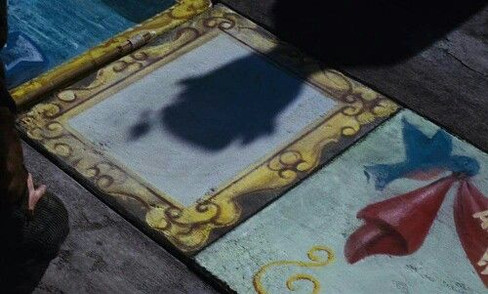
In the story, Mary Poppins meets Bert in the park with the Banks children. Bert was drawing pictures on the ground with chalk, and they entered the world within his drawings, where a fairy-tale-like world welcomed them. There, in this fantasy world, they rode a carousel and raced. However, when it began to rain in the real world, the chalk drawings were washed away by the rainwater. Simultaneously, the world they had been inhabiting vanished, and they found themselves back in the real world. Thus, the fantasy in Mary Poppins is depicted not as a realm entirely separate from reality, but as a fluid world influenced by the external reality.
In this respect, the premise of “fantasy that does not significantly disrupt reality” also serves as a medium that indirectly reveals Mary Poppins' identity not merely as a character but as a phenomenon.
Why this film has visual language? and how?

As I mentioned, Mary Poppins's identity has been demonstrated as not only the character but also the phenomenon. In case of the films that need to give the inspiration through the non-verbal to the children, it is significantly necessary to provide the visual language by using the special effects like the Animatronics.
Animatronics, unlike fully animated illusions, renders fantasy more tactile and credible by sharing physical mass and real space. This resembles how imaginary beings in a child's mind occupy the same space as furniture or props within an actual room, blurring the boundary between reality and fantasy.
This approach was later adopted in films such as < Five nights at Freddy's (2023) >, and < Jurassic Park (1993) >. Commonly, it reinforces the world's credibility by placing unrealistic characters within the physical rules of the real world. Similarly, this project seeks to express the moment when imagination encroaches upon reality by setting fantasy elements to operate within the same visual and spatial logic as the real space.
Ultimately, the animatronics mindset is not merely a technical reference but an attitude that treats fantasy not as an “added embellishment” but as the materialization of emotion coexisting with reality, deeply connected to the direction of this work's production.
Thus, it can be said that animatronics techniques were employed as a visual language to depict the phenomena occurring with Mary Poppins and the surrounding characters, as well as the emotional intimacy between them.


댓글