Unit06 _ Concept Statement
- seobin051013
- 1월 20일
- 4분 분량

최종 수정일: 2월 5일
Decision about the direction
I decided to reinterpret it as Mary Poppins from an adult's perspective, recalling the childhood of the 1960s, and set the theme of the 1960s atmosphere with Mary Poppins' unique personality, magic, and fantasy contrary to confusion and stagnation.

This was made for the initial mood board to make the clear direction of the concept. I chose the main colors which were used to consider as trendy colors in 1960s and matched them with the model's picture that has those vivid colors. I'm going to compare this one and the final mood board after the character design, environment design, and concept art.
( 20th January 2025 )
Why I have chosen the 1960s?


Just as this film was made recalling the Edwardian era of 1910 through the lens of the 1960s, Mary Poppins will be reinterpreted through a modern lens, recalling the 1960s. The 1960s were chosen as the setting because it was a period of liberation and chaos coexisting, centered around London. Though called Swinging London, it was also a time of class mobility, women entering the workforce, and the rise of free fashion. This was due not only to sexual liberation but also to Britain's loss of part of its identity and the collapse of traditional order following the decline of imperialism, which transformed family structures.
Consequently, Britain's youth in the 1960s began expressing distrust toward home, nation, school, and workplace, asking questions like, “Does that make us happy?” and “Why must we live that way?
Even Mrs. Banks, who appeared with an active stance on women's suffrage, could not escape patriarchy. By the 1960s, women's suffrage was already established, employment opportunities increased, and discussions on feminism began to flourish. Yet simultaneously, the image of the ‘ideal housewife’—whose career was interrupted after marriage—persisted in society. Within this context, Mary Poppins' presence presented a new female archetype not only to the characters within the film but also to the ‘audience outside the film’.
She transcended the role of a mere nanny who cared for and managed children. She understood and interacted with children from their perspective, not that of adults, and did not merely use magic to create a fairy-tale world.

Therefore, just as Disney produced Mary Poppins in the 1910s from a nostalgic perspective in the 1960s, the direction was set to have a child who has grown into an adult recall the Mary Poppins of the 1960s from a modern perspective.
While maintaining the existing fantasy that coexists without disrupting the order of reality, the appearance and occupations of characters, including Mary Poppins, will be updated to match historical accuracy.
Why Mary Poppins?

Just as this film has long been cherished by many as both the original novel and its cinematic and theatrical adaptations, the story's transmission from novel to film, and then from film to new film versions, has sometimes seen the characters' personalities or settings diverge slightly from the author's original intent.
Born in Australia in 1899, British author Pamela Lyndon Travers reportedly disliked the animated scenes in the Disney film of the same name at the time, and there were clashes of opinion with Disney over its production for a full 23 years. Unlike the portrayal in the films, the character of Mary Poppins in the original work is described as brazen and prone to talking back, even though she is an employee in someone else's household. It is said that the author did not want this aspect of Mary Poppins' character to be lost through Disney's adaptation.

In this unit, reinterpreting the film was important not only for its novelty and creativity, but ultimately for understanding the essence of the work and how to reinterpret it using different visual languages. I wanted to realistically reimagine the characters based on the social changes of the 1960s and the thoughts people had about the society they lived in at the time.
Therefore, just as Mary Poppins freely traverses the boundary between reality and fantasy without significantly disrupting the real world, her appearance will not stray far from the fashion of young, unmarried women in the mid-to-late 1960s. However, she will be depicted as a woman sporting the pixie cut, a hairstyle that caused a sensation at the time for being revolutionary.
Furthermore, unlike the match-seller in the original work, Bert's profession will be depicted as a compromise with reality, yet he will remain portrayed as a passionate artist character.
Comparison between the initial mood board and the final one _ 4th February 2026
After completing the character designs for two characters and three environment concept art pieces, I compared the mood boards to the initial mood board. In the initial mood board, relatively high-saturation colors like light green, yellow, orange, crimson, and pink were the most eye-catching. In contrast, the mood board created later draws the eye more to beige and a relatively subdued tone of red. Additionally, while not low in brightness like faded old photographs, the colors have lower saturation. Illustrations resembling a child's drawings on paper, toys, and 1960s movie posters harmonize together.

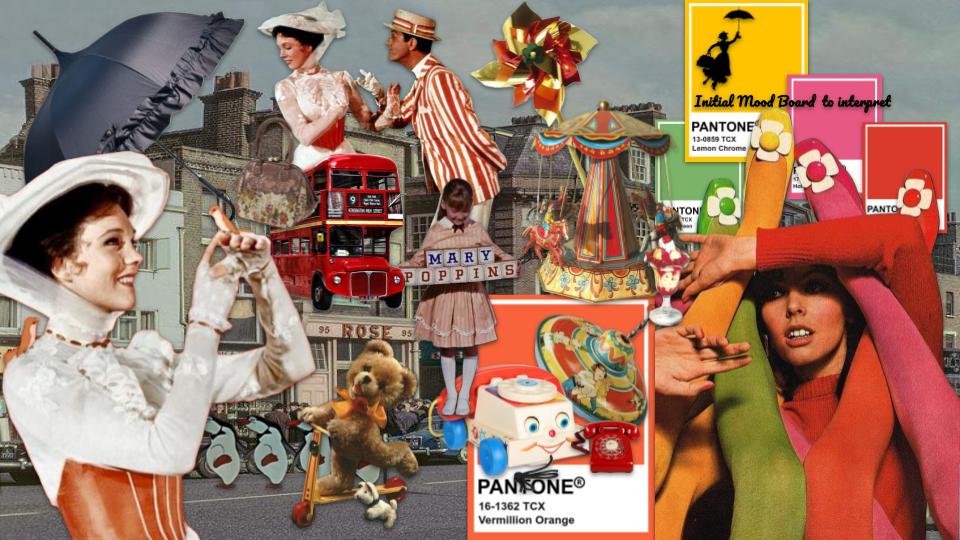

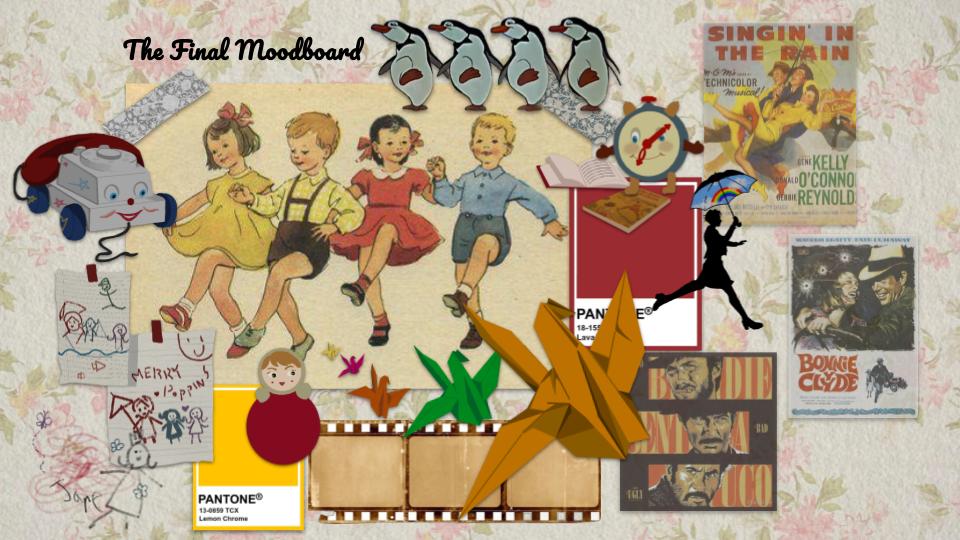
The reason for creating two mood boards before and after the character design and concept art work was to visually and intuitively compare how the initial direction of the work developed or changed. This approach allowed me to confirm whether what I intended in the initial conceptual phase was decisively realized and enabled me to objectively observe my workflow.


댓글